NYC Congestion Relief Zone Explained for Travelers
Updated Nov 8, 2026
The CRZ toll is the charge for entering the Congestion Relief Zone under the rules described below. The CRZ toll is an electronic entry charge for Manhattan local streets and avenues south of and including 60th Street; a passenger car with valid E-ZPass pays $9 peak or $2.25 overnight, according to the MTA. True North VIP is a chauffeured car service based in New York City, serving Manhattan, Brooklyn, Queens, the Bronx, Staten Island, Long Island, Westchester, New Jersey and Connecticut. See NYC airport car service and request your route online.
Reserve
Book your ride
NYC Congestion Relief Zone Explained for Travelers at a glance
| Detail | Answer |
|---|---|
| Planning detail | CRZ costs depend on vehicle, time and payment method. Private cars pay a daily-entry toll; eligible taxis and FHVs use a per-trip plan. Bridge and tunnel tolls, the New York State congestion surcharge and the MTA charge follow separate rules. |
| Vehicles | Executive Sedan: 2 passengers; Luxury Sedan: 3; Executive SUV and Luxury SUV: 6 each; Executive Sprinter: 13; Jet Sprinter: 10. |
| Sprinter quotes | Executive and Jet Sprinters are quoted on request. |
| Pricing basis | Distance-based, taxes, tolls and fees included; gratuity optional. |
| How to book | Book online or call 888-887-0324, 24/7. |
Quick answers
What is the CRZ toll?
CRZ stands for Congestion Relief Zone. The CRZ toll is the MTA's electronic charge for entering Manhattan's local streets and avenues at or below 60th Street. A passenger car with a valid E-ZPass pays $9 at peak times or $2.25 overnight, according to the MTA.
Is there a CRZ toll plaza or exit plaza?
No. There is no physical CRZ toll plaza, booth or exit plaza. The MTA records each entry electronically, and leaving the zone has no separate toll. A CRZ line on a statement marks a toll-program entry, not a physical booth or exit facility.
What does CRZ mean on my E-ZPass statement?
CRZ means "Entered Congestion Relief Zone." The Agency field may show CBDTP, the Central Business District Tolling Program. Crossing-credit codes such as CX1, CX2 or CXC show up as separate lines.
Riding with us? The full price shown before you book already includes tolls and the CRZ charge. Book a Manhattan car.
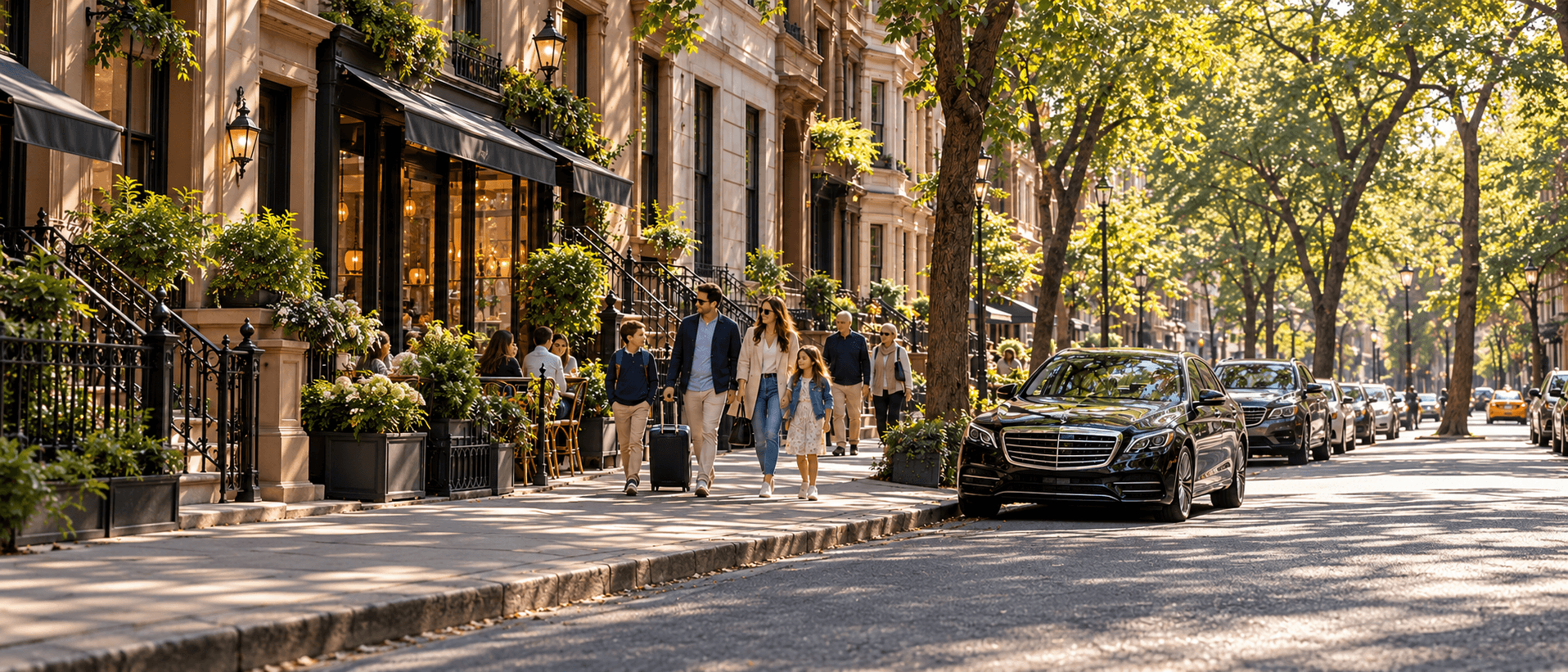
Avoid toll surprises with a quoted car service fare.
CRZ costs depend on vehicle, time and payment method. Private cars pay a daily-entry toll; eligible taxis and FHVs use a per-trip plan. Bridge and tunnel tolls, the New York State congestion surcharge and the MTA charge follow separate rules.
What Is the CRZ Toll and Congestion Relief Zone?
The CRZ toll is an electronic entry charge for Manhattan local streets and avenues south of and including 60th Street.
The Basics
The Central Business District Tolling Program began on Jan 5, 2025. The MTA records a charge when a vehicle enters the CRZ's local streets and avenues south of and including 60th Street, with designated through-road exclusions.
Passenger cars that enter more than once in a calendar day use the first-entry rate. A plate linked to a valid E-ZPass account receives the E-ZPass rate; other plates are billed through Tolls by Mail at the higher listed rates. Eligible taxis and FHVs follow the separate per-trip program below.
Why Congestion Pricing Exists
The program funds MTA capital improvements, including subway modernization, station accessibility and bus network work, while managing traffic in Manhattan's central business district.
Who Pays What
Passenger cars and motorcycles pay once per calendar day; trucks and buses pay per entry. Eligible taxi and FHV passengers pay per qualifying trip under the MTA's Per-Trip Charge Plan (PTCP). The billing unit matters: a private car's first daily entry sets its toll, while each eligible FHV trip has its own passenger charge.

Zone Boundaries Explained
The CRZ covers Manhattan local streets and avenues south of and including 60th Street, with designated through-road and tunnel-connection exclusions.
The 60th Street Line
The north boundary includes 60th Street and follows Manhattan local streets and avenues, subject to listed through-road exceptions. Times Square, Penn Station, Grand Central, the Financial District, SoHo, Tribeca and Chelsea are within the zone. A trip to an address north of 60th Street can still cross it. Eligible taxi and FHV trips are covered to, from, within or through the CRZ; private passenger cars pay on entry.
Through-Traffic Exemptions
Through trips that remain on the FDR Drive or West Side Highway/Route 9A use excluded roadways. The MTA also excludes specified Hugh L. Carey Tunnel connections to West Street. Routes connecting an excluded roadway to a bridge or tunnel may use local streets; the MTA route map identifies each approach.
Detection Points
The MTA collects tolls electronically at zone entry points. Its traffic data article describes 110 detection points and 12 detection areas. Some equipment on excluded roads or beyond the boundary monitors traffic, while toll collection equipment records CRZ entries.
Toll Rates by Vehicle Type
A passenger car with linked E-ZPass pays $9 peak or $2.25 overnight in 2026, according to the MTA. The MTA's toll schedule lists the rates for other vehicles and for Tolls by Mail; the table shows how each vehicle type is billed.
| Vehicle | Billing unit |
|---|---|
| Passenger cars and small commercial vehicles | Once per calendar day |
| Motorcycles | Once per calendar day |
| Small single-unit trucks and qualifying buses | Per entry |
| Multi-unit trucks and tour buses | Per entry |
Passenger cars and motorcycles use the first-entry rate once per calendar day, from midnight through 11:59 p.m.; trucks and buses pay per entry. Tolls by Mail rates are higher. A plate linked to a valid in-state or out-of-state E-ZPass receives the E-ZPass rate.
Peak vs Off-Peak Hours
Peak hours are weekdays from 5 a.m. to 9 p.m. and weekends from 9 a.m. to 9 p.m. Overnight hours are 9 p.m. to 5 a.m. weekdays and 9 p.m. to 9 a.m. weekends. Tolling runs around the clock; taxi and FHV per-trip amounts stay the same at every hour.
Exemptions
Qualifying bus categories are exempt. The MTA administers other exemptions and reduced rates through approval or enrollment. Disability plates and permits alone do not establish eligibility. Enrolled low-income participants pay a reduced peak toll after ten qualifying trips in a calendar month.
Is There a CRZ Toll Plaza or Exit Plaza?
There is no physical CRZ toll plaza or exit plaza. The MTA records entries electronically, and leaving the zone has no separate toll.
What Do CRZ and CBDTP Mean on an E-ZPass Statement?
On an E-ZPass statement, CRZ means "Entered Congestion Relief Zone"; CBDTP identifies the Central Business District Tolling Program in the Agency field.
| Statement label | Meaning |
|---|---|
| CRZ | Entered Congestion Relief Zone |
| CBDTP | Central Business District Tolling Program, shown as the agency for the toll program |
| CX1 or CX2 | CRZ Crossing Credit OneWay |
| CXC | CRZ Crossing Credit |
The E-ZPass New York glossary defines CRZ as an entry into the zone. MTA statement instructions use CBDTP in the Agency field for tolls on E-ZPass statements and Tolls-by-Mail invoices. Crossing credits appear as separate account entries. When reviewing a statement, compare the Agency field, CRZ entry and credit line separately; each label describes a different part of the toll record. A CRZ label identifies a toll-program entry, not a physical booth or exit facility.
The FHV Surcharge: What Car Service Clients See
The PTCP charges $0.75 per qualifying taxi or non-high-volume FHV trip and $1.50 per high-volume FHV trip to, from, within or through the CRZ.
Who Pays the $0.75 or $1.50 Per-Trip Charge?
The passenger pays each eligible per-trip charge. The TLC-licensed vehicle's base or TSP must be enrolled and in good standing under PTCP.
$0.75 and $1.50 Per Trip
The table shows the PTCP charge by taxi and FHV category.
| Taxi or FHV category | CRZ charge under PTCP | How it is applied |
|---|---|---|
| Yellow or green taxi | $0.75 per trip | Passenger charge for each qualifying trip |
| Black car or other non-high-volume FHV | $0.75 per trip | Passenger charge for each qualifying trip |
| High-volume FHV | $1.50 per trip | Passenger charge for each qualifying trip |
For a base or TSP outside PTCP, the TLC says the vehicle owner may owe the standard daily toll, up to once per calendar day.
Why the FHV Rate Is Lower Than Passenger Cars
Private passenger vehicles pay by daily entry; eligible taxis and FHVs under PTCP pay by qualifying trip. A vehicle making several FHV trips can incur several per-trip charges in one day.
How True North VIP Handles It
The MTA schedule explains general vehicle categories. True North VIP's route price is distance-based, so enter the pickup, destination and time to see the exact amount for the requested trip.
E-ZPass Tunnel & Bridge Credits
A valid E-ZPass can earn a passenger-car CRZ credit for a peak-period entry through a qualifying tolled tunnel; the MTA publishes the credit amounts.
Which Crossings Qualify for Credits
The MTA lists the Lincoln Tunnel, the Holland Tunnel, the Queens-Midtown Tunnel and the Hugh L. Carey Tunnel. Credits vary by tunnel, direction and vehicle category, and the MTA's schedule lists the maximum credit for each vehicle category.
Credits apply during peak periods and require a valid E-ZPass. The toll and credit appear as separate entries, and the crossing toll remains a separate charge.
How Credits Work for Car Service Passengers
The credit posts to the vehicle's E-ZPass account; a qualifying taxi or FHV passenger charge remains a separate per-trip item. Check for a CRZ entry and a crossing-credit code such as CX1, CX2 or CXC on your own statement. For more, see E-ZPass tunnel credits.
Impact on Airport Transfers
Airport trips are affected when an eligible taxi or FHV travels to, from, within or through the CRZ; a private car's charge depends on entering local CRZ streets. An airport name alone does not determine the charge: the route, pickup and destination matter.
| Airport transfer example | CRZ rule to check | Practical takeaway |
|---|---|---|
| JFK, LGA or Newark to an address south of 60th Street | Qualifying FHV trip charge can apply | Enter the exact destination |
| Manhattan pickup in the zone to an airport | The qualifying FHV trip includes travel from the CRZ | A zone pickup keeps the CRZ rule relevant for an airport ride |
| Airport ride to an address north of 60th Street | Route may pass through the CRZ | Use the full route and vehicle category |
| Through-road route | Private car toll depends on entry to local CRZ streets | Check the roadway connection |
For an FHV, a qualifying airport trip can fall under PTCP even when the airport is outside Manhattan, if the trip goes to, from, within or through the CRZ. For a private car, the daily toll is tied to entry onto local CRZ streets. The route distinction is especially useful for addresses north of 60th Street and rides using a through roadway.
Our Distance-Priced Airport Transfer Prices Include Tolls and Fees
True North VIP airport totals include applicable taxes, tolls and fees; gratuity is optional. Prices are distance-based, and the exact total is shown before you request a ride.
Airport Pickup and Meet-and-Greet
Without meet and greet, your chauffeur meets you at the arrivals curb. At JFK Terminals 5 and 7, car service passengers take the free AirTrain to the Howard Beach car service lot. At LaGuardia, car service pickups for Terminal B are on Level 2 of the Terminal B parking garage, and Terminal C pickups are in the arrivals inner lane. Terminal A has had no airline flights since May 2026. At Newark Terminal C, your chauffeur meets you at the arrivals curb or in the Terminal C Garage, Level 3. We track airline flights. Airport waiting is a 60-minute wait time after a domestic landing and a 90-minute wait time after an international landing; every regular pickup has a 15-minute grace period. Child seats are $25 each in SUVs and Sprinters, never in sedans.
A $25 meet and greet adds an inside-terminal meeting, name sign and luggage help. A dedicated greeter is $150. We also meet arriving private flights at JFK, Newark, Teterboro (TEB), Westchester (HPN), Republic (FRG), Long Island MacArthur (ISP), Morristown (MMU), East Hampton (HTO), Gabreski in Westhampton Beach (FOK) and Trenton-Mercer (TTN); your chauffeur meets you in the FBO lobby, or planeside when the FBO allows it. See JFK car service, LGA car service, Car Service to Newark Airport and airport meet and greet for airport details. Read the airport-trip congestion pricing guide for a route-by-route explanation.
How CRZ Interacts with Existing Surcharges
The MTA CRZ toll and New York State surcharge are separate; a qualifying black-car trip can carry $0.75 CRZ and $2.75 state charges.
Two Separate Surcharges
The CRZ charge is tied to an entry by a private passenger vehicle or a qualifying taxi/FHV trip in the relevant program. The state surcharge applies under a different rule: the trip must begin and end in New York State and begin, end or pass through Manhattan south of and excluding 96th Street.
| Charge | Example amount | What triggers it |
|---|---|---|
| New York State surcharge, medallion taxi | $2.50 per ride | Eligible New York State trip meeting the state zone conditions |
| New York State surcharge, other for-hire trip | Generally $2.75 per ride | Eligible New York State trip meeting the state zone conditions |
| New York State surcharge, shared trip | $0.75 per ride | Eligible shared trip meeting the state zone conditions |
| CRZ, yellow or green taxi under PTCP | $0.75 per trip | Eligible taxi trip to, from, within or through the CRZ |
| CRZ, black car or non-high-volume FHV under PTCP | $0.75 per trip | Eligible FHV trip to, from, within or through the CRZ |
| CRZ, high-volume FHV under PTCP | $1.50 per trip | Eligible high-volume trip to, from, within or through the CRZ |
The state surcharge requires both trip endpoints to be in New York State, so a New Jersey to New York ride does not meet that condition. See NY State surcharge vs NYC congestion pricing for the separate tax rule.
Total Surcharges for a Typical Black Car Trip
When both programs apply, an enrolled black-car trip has $3.50 in surcharges ($2.75 state plus $0.75 CRZ). The comparable total is $4.25 for a high-volume FHV and $3.25 for a medallion taxi.
What This Means for Your Trip
For an airport or Manhattan ride, the pickup, destination, vehicle category and route determine which toll rule applies. A quick check helps: identify whether the trip is a private passenger car or an eligible FHV; check the entry time and payment method for a private-car toll; and use the PTCP category for an eligible taxi or FHV trip.
No Surprise Fees with True North VIP
Enter your pickup, destination and travel time when requesting a ride. For an airport pickup, add the terminal and flight details; for hourly service, include the start location and planned hours.
Faster Travel Times in the Zone
The MTA's first-year report counted 27 million fewer vehicle entries, an 11% reduction, and savings of as much as 15 minutes each way on some trips. Build airport check-in, meeting or event time into your pickup plan.
Off-Peak Strategies
Private-car drivers can compare peak and overnight tolls in the table; taxi and FHV per-trip charges stay the same at all hours. See hourly chauffeur rates in NYC to compare hourly service with a one-way ride.
For Corporate Clients
For a business ride, enter the company pickup and destination and include billing instructions in your request. See Corporate Accounts for company travel details.
Frequently Asked Questions
These answers explain CRZ amounts, passenger charges, airport trips, E-ZPass labels and credits, and the state surcharge.
When did NYC congestion pricing start?
+
The Congestion Relief Zone tolling program began on Jan 5, 2025, and MTA guidance says collection continues.
How much does congestion pricing cost for a black car trip?
+
An enrolled black car carries a $0.75 CRZ charge per qualifying trip. If the New York State surcharge also applies, the combined total is $3.50: $2.75 state plus $0.75 CRZ.
Are taxis exempt from congestion pricing?
+
Yellow and green taxis enrolled in PTCP pay $0.75 per qualifying trip to, from, within or through the CRZ. The passenger charge replaces the standard daily-entry toll for that taxi.
Does congestion pricing apply to airport transfers?
+
Yes. An eligible taxi or FHV trip is covered to, from, within or through the CRZ; a private passenger car pays the daily toll on entry.
Are congestion pricing surcharges included in True North VIP fares?
+
Yes. True North VIP airport totals include applicable taxes, tolls and fees. The exact distance-priced total is shown before you request a ride, and gratuity is optional.
What is the difference between peak and off-peak rates?
+
Peak hours are weekdays from 5 a.m. to 9 p.m. and weekends from 9 a.m. to 9 p.m. Overnight is 9 p.m. to 5 a.m. weekdays and 9 p.m. to 9 a.m. weekends. Eligible taxi and FHV charges stay the same at all hours.
Do E-ZPass tunnel credits reduce the cost for car service clients?
+
A valid E-ZPass can credit an eligible vehicle's CRZ toll after a qualifying peak-period tunnel entry. The vehicle-account credit is separate from the taxi or FHV passenger charge under PTCP.
Is congestion pricing the same as the New York State congestion surcharge?
+
No. The MTA toll and state surcharge have different trip rules and amounts, and a qualifying ride can carry both.
Has congestion pricing actually reduced traffic?
+
The MTA's first-year report counted 27 million fewer entries, an 11% year-over-year decrease, and savings of as much as 15 minutes each way on some trips.
Is there a CRZ toll plaza or exit plaza?
+
No. Electronic equipment records entries; the MTA does not collect a separate exit toll.
What does CRZ or CBDTP mean on an E-ZPass statement?
+
CRZ means "Entered Congestion Relief Zone." CBDTP identifies the tolling program in the Agency field; CX1, CX2 and CXC appear as separate crossing-credit entries.
Do you pay congestion pricing on the FDR Drive?
+
A vehicle that stays on the FDR Drive uses an excluded roadway for that through movement. A route using local streets at or below 60th Street follows the CRZ entry rule.
How does NYC congestion pricing work?
+
NYC congestion pricing applies to the Congestion Relief Zone, with the charge depending on vehicle category and the trip. Passenger cars pay once per calendar day, while eligible taxi and for-hire passengers pay $0.75 per qualifying taxi or non-high-volume FHV trip and $1.50 per high-volume FHV trip. New York State congestion surcharges are a separate charge.
How much is the NYC congestion pricing toll for cars?
+
Passenger cars with E-ZPass pay $9 in the peak period and $2.25 overnight, according to the MTA. Eligible taxi and for-hire trips instead carry a per-trip charge of $0.75 for a taxi or non-high-volume FHV and $1.50 for a high-volume FHV. Check the MTA's schedule for the vehicle and travel period.
What area does NYC congestion pricing cover?
+
The Congestion Relief Zone covers local streets and avenues south of and including 60th Street. The guide identifies excluded through-road movements on the FDR Drive, West Side Highway and specified Hugh L. Carey Tunnel connections to West Street. A later entry onto local streets can have a zone charge.
All surcharges included. No surprises.
Request an airport or Manhattan ride through Book now, or call 888-887-0324. True North VIP dispatch and phone support are available 24/7.